TSP Planning Report September 2023
Facts:
- The G Fund rate for September 2023 increased to 4.25%.
- The Fed Funds interest rate increased to 5.5%.
- This month’s unemployment rate increased from 3.5% to 3.8%.
- The 2nd Estimate for Q2 GDP came in at 2.1%.
- PMI (Purchasing Managers Index) expanded ever-so-slightly after 3 months of contracting, reading 50.1 this month (any reading above 50 represents expansion).
- The S&P 500 (C Fund) decreased 1.6% in August. Thus far in September, S&P 500 is down further, by roughly another 4%. YTD, S&P500 is up 12%.
Assessment:
Last month I highlighted the looming Defaults. That is still a concern.
The Fed raising interest rates is a sign that inflation still needs to be combatted.
But, that just exacerbates a growing looming real estate default. In the words of Fitch Ratings:
“In the U.S., actual high-yield (HY) and institutional leveraged loan (LL) default rates soared to 2.6% and 3.0% in the trailing 12 months (TTM) to July 2023, from 0.8% and 1.0% at mid-2022. We anticipate these rates to rise further as issuers face persisting macroeconomic challenges and higher costs of debt.”
Allow me to illustrate:
Typical commercial real estate loans have a 5-yr term. That means, in 5-yrs they need to be either satisfied or refinanced.
However, when it’s time to refinance, instead of holding a 4% mortgage from 2018, they are forced to refinance into an 8%+ mortgage in 2023. That, by itself, is a challenge. However, it gets worse.
Commercial real estate values have declined. A building that was bought for $10M in 2018, may now be worth $8M in 2023. Assuming a 20% LTV, the loan on that original $10M property was $8M. When it comes time to refinance, if the property is now valued at $8M, the LTV would only allow a loan of $6.4M. That means the property owner needs to somehow find $1.6M of cash just to refinance the original $8M loan.
When confronted with this decision – either cough up another $1.6M and refinance into costly 8%+ loans, or cut your losses and walk away – it’s not hard to foresee many owners walking away from their loans, and defaulting.
Market Uncertainty.
In the past few weeks, we’ve seen a steep market decline. This is largely a sell-off prompted by bleak company forecasts and also market (investor) uncertainty. This is common, normal, but also not a reason to sell. Companies may have announced bleak near-term forecasts but that doesn’t mean the company is going out of business. In the future, the economy will stabilize, investors will regain confidence, and your portfolio will grow again. We just have to weather the discomfort for now.
Bottom Line:
Don’t panic sell. Yes, we are not in the clear and I am sticking with my current recommended portfolios. But I am quite confident in the power of companies to make profits.
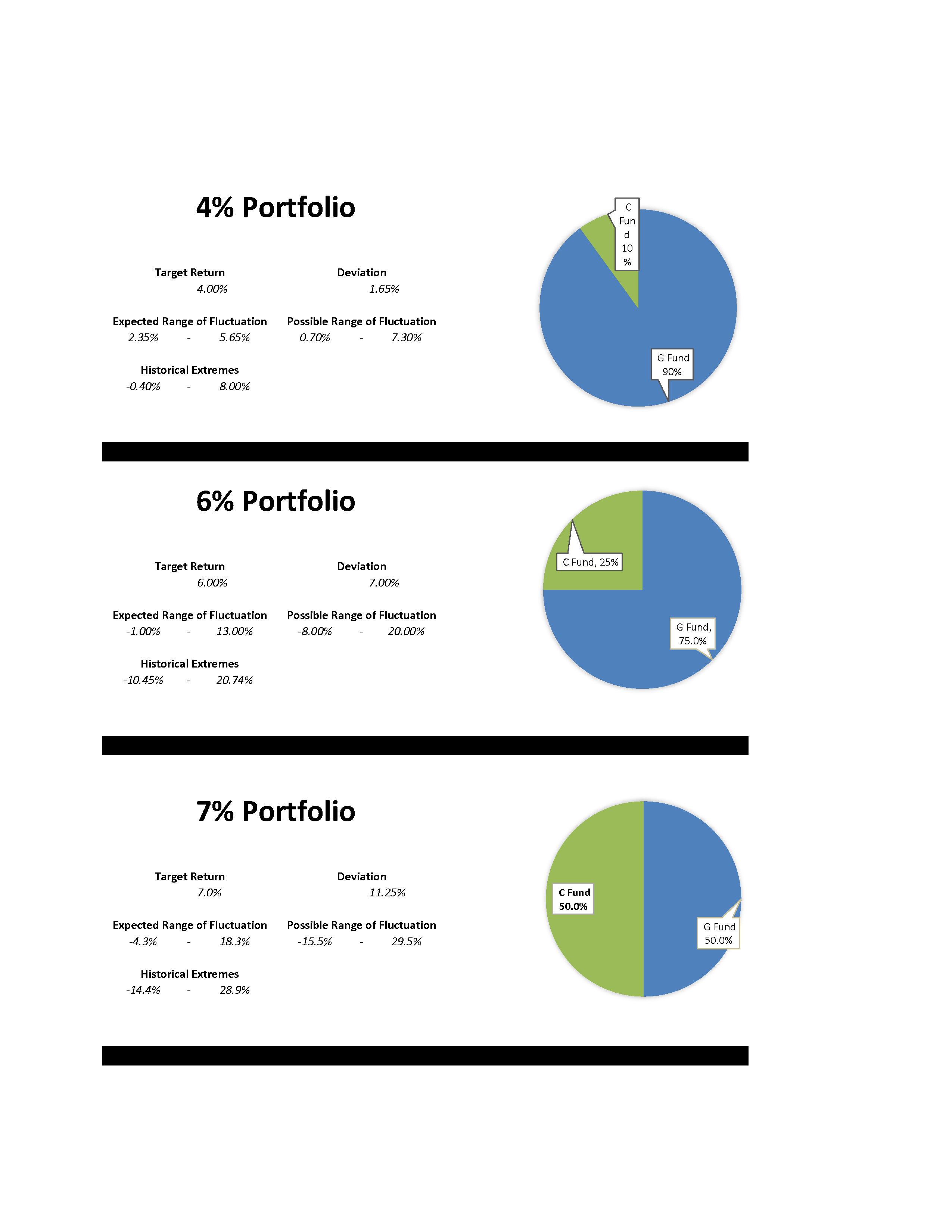
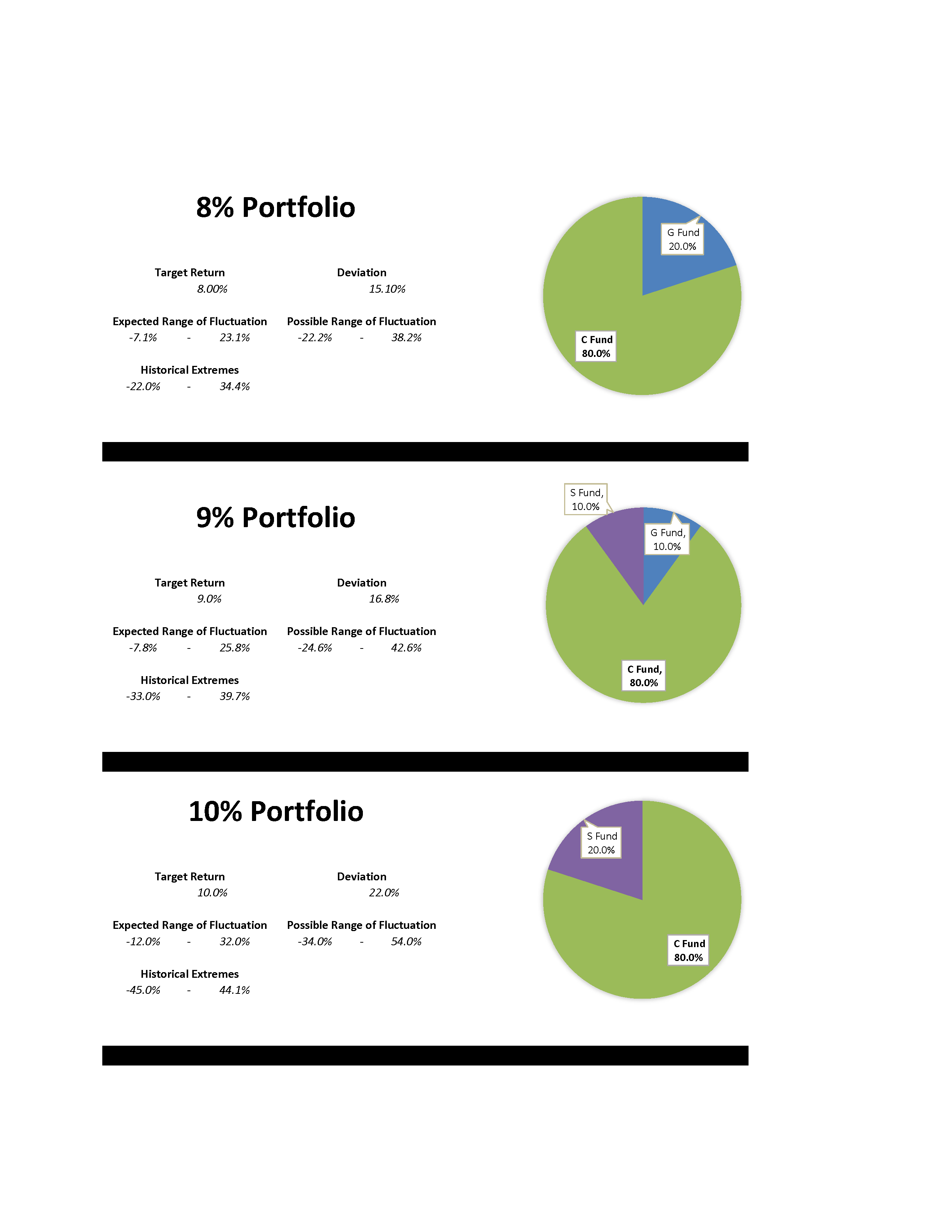
See this month’s recommended portfolios. DON’T JUST LOOK AT RATE OF RETURN. Always view the target return of each portfolio in context of its ranges of fluctuation.
Anyone who has more than 5 years before drawing income from their TSP should consider taking a more aggressive posture going forward and use my aggressive portfolios below. If you are within 5 years of retirement, you should email me to get a more customized recommendation.
If you have any questions, feel free to contact me.
Email me here – stephen@stephenzelcer.com