
It seems the theme of 2025, thus far, is WARS! We went from trade wars to hot war with Iran.
It’s scary, I get it. I’ve already had a couple of clients move everything to the G fund, against my wishes. But we’ve gotta put these wars into perspective.
Let’s start with the hot war in Iran. How did the market respond to this war? It went up! Go figure.
But if the war escalates, then what? Let’s look at the past.
Historical Market Response to Wars
Intuitively, wars introduce economic damage, uncertainty and instability, all ingredients to cause stock markets to fall. This intuition is supported by actual market performance:
- The S&P 500 dropped 18% in the three months following the start of World War I, in 1914.
- The S&P 500 dropped 30% in the year following the start of World War II. Or, more narrowly, the S&P 500 fell by 20.5% and 25.8% respectively during the 22 trading days that followed the Nazi invasion of Czechoslovakia in 1939, and the attack on France in 1940.
- The S&P 500 dropped around 11% in a single day soon after the attack on Pearl Harbor.
- The S&P 500 dropped 15% in the 6 months following the start of the Gulf War.
- The S&P 500 dropped over 17% during the Oil Crisis in 1973.
History has confirmed our intuition. The markets don’t usually respond well to war.
However, eventually the market recovers its losses.
We’re not naïve. When we invest, we are aware the market has and will have downturns. But they don’t last forever.
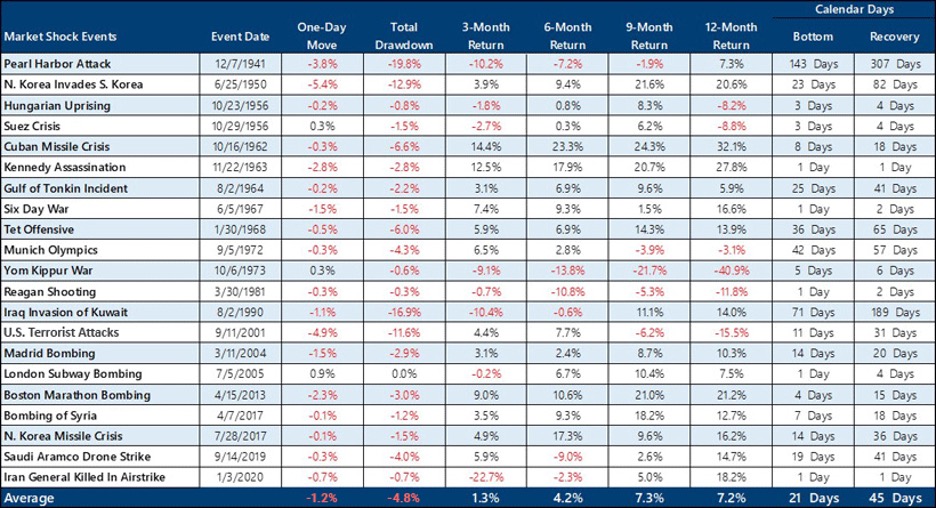
Source: LPL Research, S&P Dow Jones Indices, CFRA, Bloomberg.
Some recoveries are longer than others. But eventually you get your money back. If you invest bi-weekly, like most Feds do, you will actually be enjoying these temporarily lower prices.
Recognizing how time heals all wounds, including market downturns, you can use time to your advantage – simply be patient and you’ll see the likelihood of losing decrease.
Historical Crisis Recovery Data
Here’s a comprehensive data set showing the duration of recovery of the Dow Jones:
Event | DJIA Reaction Dates | Date Range % Gain/Loss | Six Months Later |
|---|---|---|---|
| Fall of France | 5/9/40 – 6/22/40 | -17.1% | 7.0% |
| Pearl Harbor | 12/6/41 – 12/10/41 | -6.5% | -9.6% |
| Korean War | 6/23/50 – 7/13/50 | -12.0% | 19.2% |
| Eisenhower Heart Attack | 9/23/55 – 9/26/55 | -6.5% | 11.7% |
| Cuban Missile Crisis | 10/19/62 – 10/27/62 | 1.1% | 24.2% |
| JFK Assassination | 11/21/63 – 11/22/63 | -2.9% | 15.1% |
| US Bombs Cambodia | 4/29/70 – 5/14/70 | -7.1% | 13.5% |
| Arab Oil Embargo | 10/16/73 – 12/05/73 | -18.5% | 7.2% |
| Nixon Resigns | 8/7/74 – 8/29/74 | -17.6% | 12.5% |
| USSR in Afghanistan | 12/24/79 – 1/3/80 | -2.2% | 6.8% |
| Falkland Island Wars | 4/1/82 – 5/7/82 | 4.3% | 20.8% |
| US Invades Grenada | 10/24/83 – 11/7/83 | -2.7% | -3.2% |
| US Bombs Libya | 4/14/86 – 4/21/86 | 2.8% | -1.0% |
| Financial Panic of ’87 | 10/2/87 – 10/19/87 | -34.2% | 15.0% |
| Invasion of Panama | 12/15/89 – 12/20/89 | -1.9% | 8.0% |
| Gulf War | 1/16/91 – 1/17/91 | 4.6% | 15.0% |
| World Trade Center Bombing | 2/25/93 – 2/27/93 | -0.3% | 8.5% |
| Oklahoma City Bombing | 4/18/95 – 4/20/95 | 1.2% | 12.9% |
| Asian Stock Market Crisis | 10/7/97 – 10/27/97 | -12.4% | 25.0% |
| US Embassy Bombing in Africa | 8/6/98 – 8/14/98 | -1.8% | 10.4% |
| September 11th Attacks | 9/10/01 – 9/21/01 | -14.3% | 24.8% |
| War in Afghanistan | 10/5/01 – 10/09/01 | -0.7% | 12.4% |
| Iraq War | 3/19/03 – 5/1/03 | 2.3% | 15.6% |
| London Train Bombing | 7/6/05 – 7/7/05 | 0.3% | 5.6% |
| Bear Stearns Collapse | 3/14/08 – 3/14/08 | 0.0% | -4.4% |
| Average | -5.7% | 10.9% |
Source: Morningstar and Bloomberg. As of December 31, 2019. The Dow Jones Industrial Average is a price-weighted average of 30 blue-chip stocks that are generally the leaders in their industry. It has been a widely followed indicator of the stock market since October 1, 1928. Indices are unmanaged and their returns assume reinvestment of dividends and, unlike mutual fund returns, do not reflect any fees or expenses associated with a mutual fund. It is not possible to invest directly in an index. The performance data quoted represents past performance, which is no guarantee of future results.
The table above highlights 25 international crises. In all but four cases, the DJIA returned to positive territory within six months of the end of each decline.
What About Trade Wars?
Also scary. But I don’t foresee the end of America, nor the end of the American economy, and here are SIX things I keep in mind that let me ride out the storms:
- Businesses have a vested interest in making profits. This simple truth doesn’t change with tariffs nor trade wars. So long as there are companies, they will seek profits, and as long as investors exist, they will want to invest in profitable companies.
- Investors have an interest in making money. That’s why they invest. And they will continue to put their money to work when the slightest sign of optimism returns.
- Signs have been showing that Trump is backing off his tough stance, and the market has already recovered all of its 2025 “losses.” (The truth is, you don’t lose money when the market declines. You only realize the loss when you sell. The market has declines on a daily basis. If you slept through the day, you wouldn’t even notice nor worry. The only people who lose money with market declines are those who don’t give it time and sell while it’s down.)
- Trade policies come and go. New administrations bring new policies. This is not a permanent fixture of American trade.
- Many US companies represented in the C fund and S fund have a global presence, and it could be that they would only be mildly impacted by a global trade war.
- Time is the ultimate risk mitigation technique when it comes to broad stock investing (which is exactly what the C & S funds are). If you give it time, you are usually rewarded.
“The stock market is a device for transferring money from the impatient to the patient.”
– Warren Buffett
Every time you see a drop in the stock market, there’s a transfer of wealth taking place. Which end of the transfer would you like to be on?
Bottom Line:
Wars disrupt economies, create uncertainty and are usually reflected in the short term after the start of the war. However, after the war, and even during the war, economies make their adjustments, companies continue to seek ways to be profitable, and investors eventually regain confidence and buy up the market, again.
Hold tight!
If you have any questions, feel free to contact me.
Email me here – stephen@stephenzelcer.com

